L3 Integration
Question Bank
A drone takes off vertically from a platform 2 m above the ground. Its upward velocity, in m/s, $t$ seconds after take-off is
$ v = 1.5\sqrt{t} $
for $0 \le t \le 16$.
Find the height of the drone above the ground 16 seconds after take-off.
You must use calculus and show the results of any integration needed to solve the problem.
An electric scooter starts from rest. Its acceleration, in m/s², $t$ seconds after it starts is
$ a = 3e^{-0.5t} $
for $0 \le t \le 20$.
Find the velocity of the scooter 4 seconds after it starts.
Give your answer correct to 3 significant figures.
You must use calculus and show the results of any integration needed to solve the problem.
A mass hanging on a spring bounces up and down. Its velocity, in m/s, $t$ seconds after it passes upwards through its rest position is
$ v = 0.3\cos 2t $
for $0 \le t \le 10$, with upwards positive.
Find the displacement of the mass from its rest position when $t = 1.2$.
Give your answer correct to 3 significant figures.
You must use calculus and show the results of any integration needed to solve the problem.
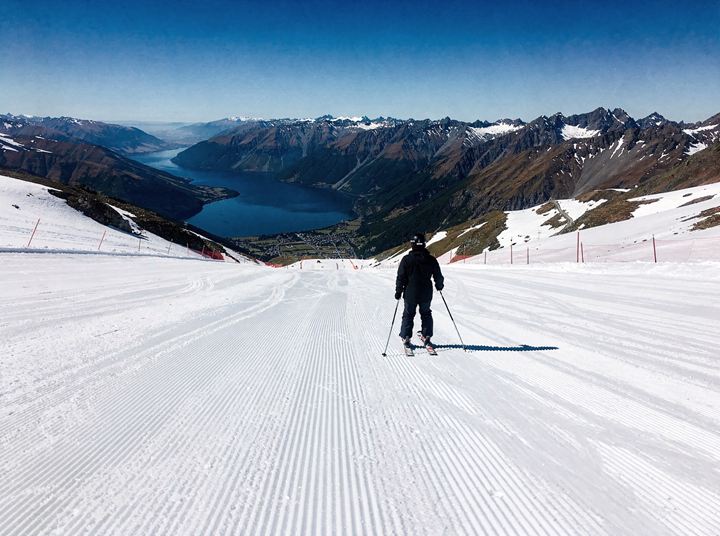
A skier pushes off down a slope at 3 m/s. Her acceleration, in m/s², $t$ seconds after she pushes off is
$ a = \frac{3}{2t + 1} $
for $0 \le t \le 20$.
Find her velocity 10 seconds after she pushes off.
Give your answer correct to 3 significant figures.
You must use calculus and show the results of any integration needed to solve the problem.
During a storm, rain falls at a rate of
$ r = \frac{12t}{t^2 + 4} $
millimetres per hour, $t$ hours after the rain starts, for $0 \le t \le 24$.
Find the total rainfall in the first 6 hours of the storm.
Give your answer correct to 3 significant figures.
You must use calculus and show the results of any integration needed to solve the problem.
A go-kart starts from rest. Its acceleration, in m/s², $t$ seconds after it starts is
$ a = 4 - 1.2\sqrt{t} $
for $0 \le t \le 10$.
Find the distance the go-kart travels during the 5th second of its motion.
Give your answer correct to 3 significant figures.
You must use calculus and show the results of any integration needed to solve the problem.
A cyclist starts from rest at a set of traffic lights. Her velocity, in m/s, $t$ seconds later is
$ v = \frac{8t}{t + 4} $
for $0 \le t \le 60$.
Find the distance she has travelled when her velocity reaches 6 m/s.
Give your answer correct to 3 significant figures.
You must use calculus and show the results of any integration needed to solve the problem.
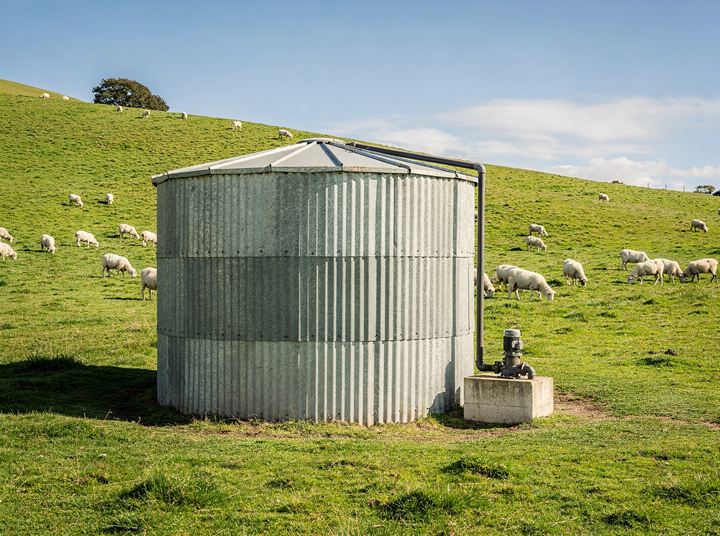
A farm water tank has 500 litres of water in it. At $t = 0$, a pump starts filling the tank at a constant 30 litres per minute.
At the same time, a valve at the bottom of the tank is gradually opened, so that water flows out at a rate of $6\sqrt{t}$ litres per minute, $t$ minutes later, for $0 \le t \le 60$. The tank does not overflow.
Find the greatest amount of water in the tank.
You must use calculus and show the results of any integration needed to solve the problem.
A car accelerates along a motorway on-ramp. Its acceleration, in m/s², $t$ seconds after it passes the start of the ramp is
$ a = 0.8e^{0.1t} $
for $0 \le t \le 10$. When $t = 10$ the car reaches the end of the ramp, travelling at 25 m/s.
Find the length of the on-ramp.
You must use calculus and show the results of any integration needed to solve the problem.
A small robot moves along a straight track. Its velocity, in cm/s, $t$ seconds after it starts is
$ v = 6 - 2\sqrt{t} $
for $0 \le t \le 16$.
(a) Find how far the robot is from its starting point when $t = 16$.
(b) Find the total distance the robot travels in the 16 seconds.
You must use calculus and show the results of any integration needed to solve the problem.
An electric car has a 64 kWh battery. It is plugged into a fast charger when the battery is 15% full.
$t$ minutes after it is plugged in, the battery gains charge at a rate of
$ 1.2e^{-0.02t} $
kWh per minute, for $0 \le t \le 90$.
How long does it take for the battery to reach 80% full? Give your answer to the nearest minute.
You must use calculus and show the results of any integration needed to solve the problem.
A tram leaves a stop from rest and travels in a straight line. Its acceleration, in m/s², $t$ seconds after it leaves is
$ a = 0.5\cos\frac{t}{20} $
until it next comes to rest, at the following stop.
Find the distance between the two stops.
You must use calculus and show the results of any integration needed to solve the problem.
A commuter train leaves a station from rest. For a smooth start, its acceleration, in m/s², $t$ seconds after it starts is modelled by
$ a = \frac{kt}{t^2 + 400} $
for $0 \le t \le 60$, where $k$ is a positive constant.
20 seconds after it starts, the train is travelling at 8 m/s.
Find how long it takes the train to reach a speed of 16 m/s. Give your answer in exact form.
You must use calculus and show the results of any integration needed to solve the problem.
A skydiver jumps from a hovering helicopter. Allowing for air resistance, her downward acceleration, in m/s², $t$ seconds after she jumps is modelled by
$ a = 9.8e^{-0.2t} $
for $t \ge 0$ until she opens her parachute. Her speed increases towards a terminal speed, which it never quite reaches.
How far has she fallen by the time her speed reaches half of her terminal speed?
Give your answer correct to 3 significant figures.
You must use calculus and show the results of any integration needed to solve the problem.