L3 Integration
Question Bank
Solve the differential equation
$ \frac{dy}{dx} = 3\sqrt{x} - 1 $
given that $y = 10$ when $x = 4$.
You must use calculus and show the results of any integration needed to solve the problem.
Solve the differential equation
$ \frac{dy}{dx} = 12(3x - 2)^3 $
given that $y = 5$ when $x = 1$.
You must use calculus and show the results of any integration needed to solve the problem.
Solve the differential equation
$ \frac{dy}{dx} = 6\sin 3x $
given that $y = 5$ when $x = \dfrac{\pi}{3}$.
You must use calculus and show the results of any integration needed to solve the problem.
Solve the differential equation
$ \frac{dy}{dx} = \frac{12}{(3x - 1)^2}, \quad x > \frac{1}{3} $
given that $y = 1$ when $x = 1$.
You must use calculus and show the results of any integration needed to solve the problem.
Solve the differential equation
$ \frac{dy}{dx} = \frac{4}{2x - 1}, \quad x > \frac{1}{2} $
given that $y = 5$ when $x = 3$.
Hence find the value of $y$ when $x = 13$. Give your answer in exact form.
You must use calculus and show the results of any integration needed to solve the problem.
Solve the differential equation
$ \frac{dy}{dx} = \sqrt{2x + 5} $
given that $y = 5$ when $x = 2$.
You must use calculus and show the results of any integration needed to solve the problem.
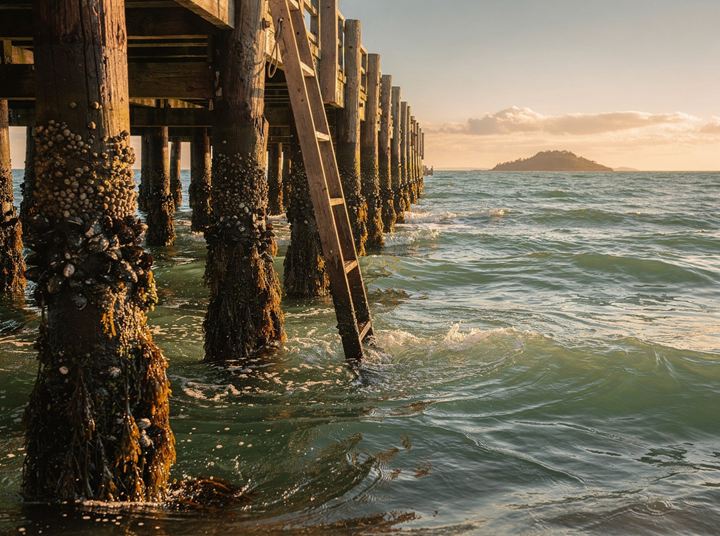
The depth of the water at the end of a wharf is $h$ metres, $t$ hours after 6 am. It changes at a rate, in metres per hour, given by
$ \frac{dh}{dt} = 0.8\cos(0.5t) $
At 8 am the depth is $4.2$ m.
Find the depth of the water at 1 pm. Give your answer correct to 3 significant figures.
You must use calculus and show the results of any integration needed to solve the problem.
Solve the differential equation
$ \frac{dy}{dx} = \frac{e^{2x} + 3}{e^x} $
given that $y = 4$ when $x = \ln 2$.
You must use calculus and show the results of any integration needed to solve the problem.
The gradient of a curve at any point $(x, y),$ where $x > 0,$ is given by
$ \frac{dy}{dx} = \frac{2}{\sqrt{x}} - \frac{3}{x} $
The curve passes through the point $(1, 5)$.
Find the exact coordinates of the stationary point on the curve.
You must use calculus and show the results of any integration needed to solve the problem.
A curve, defined for $x > -1,$ has second derivative
$ \frac{d^2y}{dx^2} = \frac{3}{\sqrt{x + 1}} $
The tangent to the curve at the point where $x = 3$ is the line $y = 9x - 1$.
Find the value of $y$ when $x = 8$.
You must use calculus and show the results of any integration needed to solve the problem.

A phone is plugged in to charge when its battery is at $20\%$. The charge in the battery, $B\%,$ $t$ minutes after it is plugged in, increases at a rate modelled by
$ \frac{dB}{dt} = \frac{k}{t + 20} $
where $k$ is a constant. After 20 minutes the battery is at $60\%$.
According to the model, how long after it is plugged in will the battery be fully charged $(100\%)$?
You must use calculus and show the results of any integration needed to solve the problem.
A plank $4$ m long rests on two supports, one at each end, and carries a load spread evenly along its length. The plank sags, as shown (not to scale).
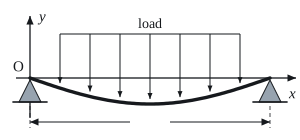
The shape of the plank is modelled by
$ \frac{d^2y}{dx^2} = 0.003(4x - x^2) $
for $0 \le x \le 4,$ where $y$ metres is the height of the plank above the level of the supports, at a horizontal distance of $x$ metres from the left-hand support.
Find the greatest sag of the plank (its greatest distance below the level of the supports). Give your answer in centimetres.
You must use calculus and show the results of any integration needed to solve the problem.