L2 Probability
Question Bank
A distributor uses two methods for shipping fragile glassware: Standard Post and Courier. The probability of damage depends on the method:
- 60% of shipments use Standard Post.
- Standard Post has a damage rate of 8%.
- Courier has a damage rate of 3%.
(a) Calculate the probability that a shipment uses Standard Post AND is damaged.
(b) Calculate the probability that a shipment uses Courier AND is not damaged.
(c) If a shipment uses Courier, what is the probability that it IS damaged?
A local weather station is analysing the accuracy of its rain prediction model. Historical data shows that rain actually occurs on 25% of all days. The model's predictive performance is summarized by the conditional probabilities:
- If rain actually occurs, the model correctly predicts rain 90% of the time.
- If rain does not occur, the model correctly predicts no rain 85% of the time.
(a) Calculate the probability that rain actually occurs AND the model predicts rain.
(b) Calculate the probability that rain does NOT occur AND the model incorrectly predicts rain (a False Alarm).
(c) What is the overall probability that the model predicts rain for any given day?
A competitive gaming tournament has two qualification rounds. Players must complete Round 1, and based on their performance, they either advance to the Championship bracket or the Consolation bracket for Round 2.
Tournament statistics show:
- In Round 1, 40% of players achieve a "Strong" performance
- In Round 1, 60% of players achieve a "Weak" performance
Round 2 placement depends on Round 1 results:
- Players with Strong Round 1 performance: 75% go to Championship, 25% go to Consolation
- Players with Weak Round 1 performance: 20% go to Championship, 80% go to Consolation
(a) Calculate the probability that a randomly selected player:
(i) achieves Strong performance in Round 1 AND plays in the Championship bracket
(ii) plays in the Consolation bracket
(b) A player is observed competing in the Championship bracket. What is the probability they had a Strong performance in Round 1?
A medical laboratory tests blood samples for a rare condition. Based on historical data, the laboratory knows that:
- 12% of samples test positive on the initial screening
- Of those that test positive, 85% are sent for confirmatory testing, while 15% are reported immediately
- Of those that test negative on initial screening, 5% are retested due to borderline results
- Of the samples sent for confirmatory testing, $\displaystyle\frac{7}{10}$ are confirmed positive and $\displaystyle\frac{3}{10}$ are confirmed negative
- Of the initially negative samples that are retested, 8% turn out to be positive and 92% remain negative
The laboratory processes the samples according to the partially complete tree diagram below:
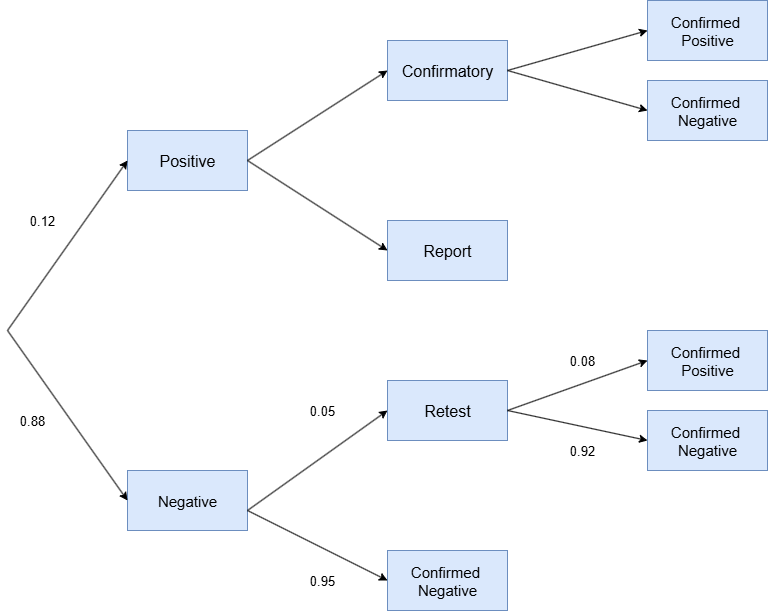
(a) What is the probability that a randomly selected sample will be reported as immediately positive (without confirmatory testing)?
(b) What is the probability that a sample will ultimately be classified as positive (either immediately reported, confirmed positive, or positive on retest)?
(c) If a sample is ultimately classified as positive, what is the probability that it went through confirmatory testing?
(d) In a batch of 5,000 samples, how many would you expect to receive a final negative result?
A medical laboratory is testing for a rare disease that affects 2% of the population.
The test used by the laboratory is not perfect:
- If a person has the disease, the test correctly identifies them (gives a positive result) 95% of the time
- If a person does not have the disease, the test incorrectly identifies them as having it (gives a positive result) 8% of the time
(a) Draw a tree diagram to model this situation
(b) Calculate the probability that a randomly selected person from the population:
(i) has the disease AND tests positive
(ii) tests positive
(c) A person receives a positive test result. By using appropriate calculations, discuss whether the patient should be worried.
A factory produces electronic components on two different production lines: Line A and Line B.
- Line A produces 40% of the total components
- Line B produces 60% of the total components
The defect rates are different for each line:
- Components from Line A have a 3% defect rate
- Components from Line B have a 5% defect rate
(a) Draw a probability tree modelling this situation.
(b) Use your tree diagram to find the probability that a randomly selected component:
(i) comes from Line A and is non-defective
(ii) is defective
(c) The factory manager states: "Since Line B produces 60% of our components, 60% of our defective components must come from Line B."
Use appropriate calculations to determine whether this statement is correct.
A secondary school conducted a survey about how students travel to school and whether they arrive on time.
The survey found that:
- 35% of students walk to school
- 45% of students take the bus
- one in five students are driven by car
The punctuality rates vary by transport method:
- Students who walk are late 12% of the time
- Students who take the bus are late 25% of the time
- Students who are driven are late 8% of the time
(a) Calculate the probability that a randomly selected student:
(i) walks to school and arrives on time
(ii) takes the bus and is late
(iii) is late
(b) If a student arrives late to school, what is the probability they took the bus?
(c) There are 2256 students in the school. The school board is trying to start a new initiative to get students to classrooms on time. They want to make sure at least 2000 students are on time each day. They intend to increase the punctuality of the busses. What percentage of the time would the bus need to be on time to meet their 2000 student goal?
A manufacturing company produces electronic components. Quality control data shows that:
- 35% of components come from Factory A, and 65% come from Factory B
- Components from Factory A have a 92% pass rate on initial inspection
- Components from Factory B have an 88% pass rate on initial inspection
- Failed components are sent for rework
- Of the reworked components from Factory A, 75% pass and 25% are scrapped
- Of the reworked components from Factory B, one in five are scrapped, and the rest pass.
(a) What is the probability that a randomly selected component is from Factory B and passes initial inspection?
(b) If a component is scrapped, what is the probability it came from Factory A?
(c) The company receives an order for 8,000 components. Based on the tree diagram, how many components should they plan to produce initially to ensure they can fulfill this order?
A ferry company runs a harbour crossing in calm and rough weather.
- 80% of crossings are in calm weather, and the rest are in rough weather.
- The company says that a passenger on a rough-weather crossing is 3 times as likely to get seasick as a passenger on a calm-weather crossing.
- The probability that a randomly chosen passenger is on a calm crossing and gets seasick is 0.048.
(i) Find the probability that a passenger on a calm crossing gets seasick.
(ii) If the company’s statement is correct, draw a probability tree and find the probability that a randomly chosen passenger gets seasick.
(iii) A passenger got seasick. What is the probability that they were on a rough crossing?
A farmer is testing a new irrigation system on their apple orchard. They have divided the orchard into plots that either receive the new irrigation system or continue with the traditional system.
Historical data shows:
- 70% of plots use the new irrigation system
- 30% of plots use the traditional system
At harvest time, apples are graded as either "Export Quality" or "Domestic Quality" based on size and appearance:
- Plots with new irrigation produce Export Quality apples 85% of the time
- Plots with traditional irrigation produce Export Quality apples 60% of the time
(a) Find the probability that a randomly selected plot:
(i) uses traditional irrigation and produces Domestic Quality apples
(ii) produces Export Quality apples
(b) An apple buyer inspects a plot and finds it produces Export Quality apples. Calculate the probability that this plot uses the new irrigation system.
(c) The farmer is considering expanding the new irrigation system. Currently, 77.5% of all apples produced are Export Quality. The farm manager wants to raise this to 82%. Find the minimum percentage of the farmers overall plots that would need to be converted from the old to the new system to meet this goal.