L3 Probability Concepts
Question Bank
A retirement village in Levin has 150 residents. The village manager found that:
- 54 residents play lawn bowls
- 75 residents belong to the walking group
- 15 residents do both of these activities.
Calculate the probability that a randomly chosen resident takes part in only one of these two activities.
A secondary school surveyed its Year 9, Year 11 and Year 13 students. Each student was asked whether they had bought lunch from the school canteen at least once in the past week.
- 160 Year 9 students, 140 Year 11 students and 100 Year 13 students took part.
- 112 of the Year 9 students had bought lunch from the canteen.
- 56 of the Year 11 students had not bought lunch from the canteen.
- Altogether, 236 of the students had bought lunch from the canteen.
One of the students who took part is chosen at random. Calculate the probability that this student is in Year 13 and had not bought lunch from the canteen in the past week.
A school held a sausage sizzle and sold 200 sausages in bread. Customers could add any of three toppings: tomato sauce, mustard and fried onions. The helpers recorded that:
- 150 sausages had tomato sauce
- 40 had mustard
- 80 had fried onions
- 30 had tomato sauce and mustard
- 60 had tomato sauce and fried onions
- 16 had mustard and fried onions
- 12 had all three toppings.
Each count of two toppings includes the 12 sausages that had all three.
One of these 200 sausages is chosen at random. Calculate the probability that it had none of the three toppings.
At a large primary school, things that are left lying around are handed in to lost property. The school's records show that:
- 40% of the items handed in have the owner's name on them
- 90% of the items with a name on them are returned to their owner
- 25% of the items without a name are returned to their owner.
Last term, 300 items were handed in to lost property. Approximately how many of these items would you expect to be returned to their owner?
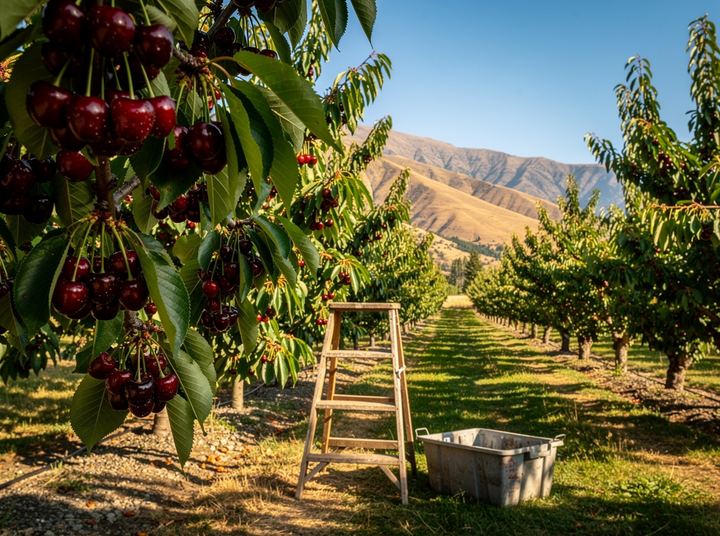
At a cherry orchard near Cromwell, three quarters of the cherries are picked by experienced pickers, and the rest are picked by new pickers.
One in twenty of the cherries picked by experienced pickers are damaged (bruised or split). One in four of the cherries picked by new pickers are damaged.
(a) Calculate the proportion of all the cherries that are picked by new pickers and are damaged.
(b) Calculate the proportion of all the cherries that are damaged.
A zoo gives keeper talks (short talks by the animal keepers) during the day. A survey of the zoo's visitors over one summer found that:
- 40% of the visitors had an annual pass
- 24% of all the visitors had an annual pass and went to a keeper talk
- 26% of all the visitors did not have an annual pass, but went to a keeper talk.
(a) What proportion of the visitors did not have an annual pass and did not go to a keeper talk?
(b) Were visitors who had an annual pass more likely to go to a keeper talk than visitors who did not have one? Support your answer with calculations.
A school's senior water polo team scores the first goal in 70% of its games. Its results show that:
- when the team scores the first goal, it goes on to win 60% of those games
- when the other team scores the first goal, the team wins only 20% of those games.
One of the team's games is chosen at random. Given that the team won this game, calculate the probability that it scored the first goal.
A vet clinic near Cambridge surveyed 120 lifestyle blocks (small farms that people live on) about the animals kept on them. It found that:
- 84 blocks keep chickens
- 32 keep goats
- 50 keep horses
- 18 keep chickens and goats
- 26 keep chickens and horses
- 16 keep goats and horses
- 6 keep all three.
Each count of two kinds of animal includes the 6 blocks that keep all three.
A block is chosen at random from those that keep horses. Calculate the probability that this block keeps goats as well, but does not keep chickens.
A visitor information centre in Taupō recorded the people who came in over one summer.
- 40% of the visitors were from overseas, and the rest were from New Zealand.
- 45% of the overseas visitors booked an activity (such as a lake cruise) at the centre.
- 20% of the New Zealand visitors booked an activity at the centre.
(a) Calculate the probability that a randomly chosen visitor booked an activity at the centre.
(b) A visitor who booked an activity at the centre is chosen at random. Is this visitor more likely to be from overseas or from New Zealand? Support your answer with calculations.
A charity op shop in Whanganui recorded the 400 items that were donated to it in March, and whether each item sold within a month.
- 200 of the items were clothing and 80 were books. The rest were homewares (kitchen and household items).
- 65% of the clothing sold within a month.
- 60 of the books did not sell within a month.
- Altogether, 180 of the 400 items sold within a month.
(a) Calculate the probability that a randomly chosen one of these 400 items was a homeware item that did not sell within a month.
(b) The shop's manager claims that donated clothing is more than twice as likely to sell within a month as donated homewares. Does this data support the manager's claim? Use calculations and statistical reasoning to support your answer.
Over four seasons, a club's senior cricket team played 40 games. The team either won or lost each game (there were no draws). The club's records show that:
- the team won the coin toss in 24 of the 40 games
- it won 15 of the games in which it won the toss
- altogether, it won 20 of the 40 games.
(a) One of these 40 games is chosen at random. Calculate the probability that the team lost the toss but won the game.
(b) Interpret the relationship between the events ‘the team wins the toss’ and ‘the team wins the game’. As part of your answer, explain whether these two events are independent. Use calculations and statistical reasoning to support your answer.
A hotel in New Plymouth recorded what 240 of its guests had from the breakfast buffet one morning. It found that:
- 120 guests had a cooked breakfast
- 80 had pancakes
- 92 had fruit salad
- 16 had all three (a cooked breakfast, pancakes and fruit salad)
- 12 had a cooked breakfast and pancakes, but no fruit salad
- 32 had a cooked breakfast and fruit salad, but no pancakes
- 24 had pancakes and fruit salad, but no cooked breakfast.
(a) Calculate the probability that a randomly chosen one of these guests had none of the three.
(b) The hotel's chef claims that guests who have pancakes are 50% more likely to have fruit salad than guests who have a cooked breakfast.
Does the data support the chef's claim? Use calculations and statistical reasoning to support your answer.