L2 Calculus
Question Bank
A particle's displacement is $s(t) = t^3 - 6t^2 + 9t$. Find its velocity and acceleration at $t=2$.
The distance, $s$ metres, of a particle from a fixed point after $t$ seconds is given by $s(t) = 2t^3 - 5t^2 + 8t + 1$. Find expressions for its velocity and acceleration.
The velocity $v$ m s⁻¹ of an object $t$ seconds after it passes a fixed point can be modelled by the function
$v(t) = 3t^2 - 8t + 5$
Find the equation for the acceleration of the object.
The velocity $v$ m s⁻¹ of a car $t$ seconds after it starts moving is given by
$v(t) = 5t^2 + 2t + 1$
Find the acceleration of the car when $t = 3$ seconds.
The velocity $v$ m s⁻¹ of a train $t$ seconds after it passes a station is given by
$v(t) = 2t^3 - 15t^2 + 24t$
At what time is the acceleration of the train equal to zero?
The position $s$ metres of an object $t$ seconds after it starts moving is given by
$s(t) = t^3 - 6t^2 + 9t$
At what time(s) is the object stationary?
The velocity of a particle is given by $v(t) = 8t - 0.5t^2$ m/s. Find the acceleration of the particle when its velocity is 14 m/s.
The acceleration of an object is given by $a(t) = 6t - 2$ m/s². Its initial velocity is 5 m/s. What is its velocity after 4 seconds?
A remote-controlled car's distance from a wall is given by $s(t) = 12t - t^3$ for $0 \le t \le 3$. Find the car's maximum distance from the wall.
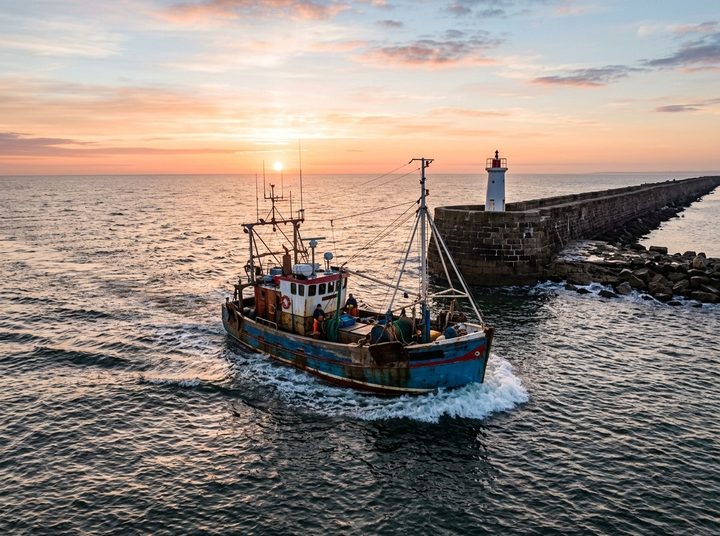
A boat's acceleration is $a(t) = 0.5$ km/h². When it starts fishing ($t=0$), its speed is 3 km/h moving away from port, and it is 80 km from port. Find its distance from the port after 6 hours.
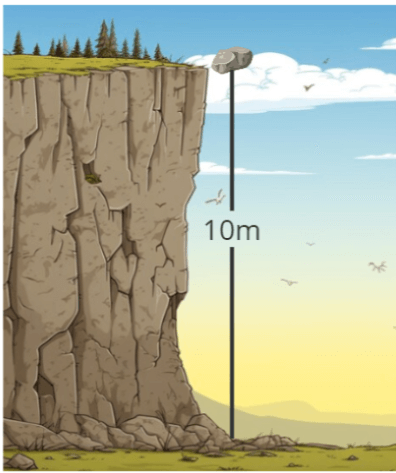
An object is dropped (from rest) off a cliff with a constant acceleration down at a rate of 9.8m/s². Initially the object is 10 m from the ground. Find when the object hits the ground. You must use calculus to find your answer.
A train is travelling at 30 m/s when the driver applies the brakes, causing a constant deceleration of 2 m/s². How far does the train travel before it comes to a complete stop?
A particle moves along a straight line. Its displacement from a fixed point O after $t$ seconds is
$s(t) = 2t^3 - 21t^2 + 60t$
metres. Find the distance between the two positions where the particle is momentarily at rest.
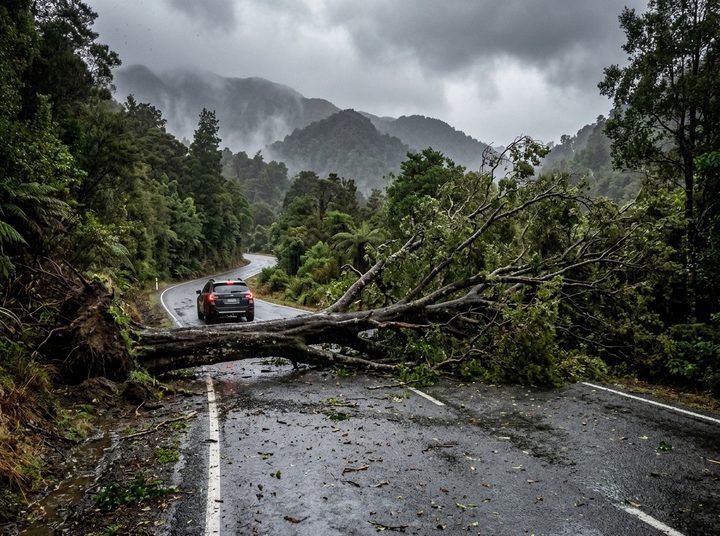
A car is travelling at $25$ m s⁻¹ when the driver sees a fallen tree across the road, $60$ m ahead.
The driver takes $0.8$ seconds to react, and the car keeps the same speed during this time. The driver then brakes, and the car slows down with a constant deceleration of $6.25$ m s⁻².
Use calculus to decide whether the car stops before it reaches the tree.
A drone is flying away from its base. Its acceleration is $a(t) = 4t - 10$ m/s². Two seconds after leaving the base, its velocity is 8 m/s. How far is the drone from its base after 5 seconds?
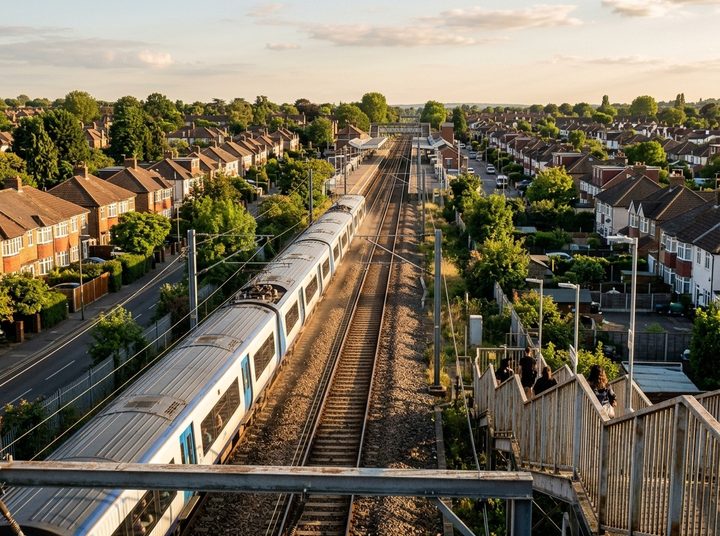
An automated train travels between two stations. As it leaves Station 1, its velocity is modelled by the function $v(t) = 0.1t^2 + 0.5t$ m s⁻¹, where $t$ is the time in seconds after leaving the station.
At the exact moment the train's acceleration reaches 2.5 m s⁻², the train's braking system is scheduled to engage to bring it to a stop at Station 2. The braking provides a constant deceleration.
The entire journey from Station 1 to Station 2 takes a total of 50 seconds.
Calculate the constant deceleration required from the braking system to ensure the train stops exactly at Station 2.
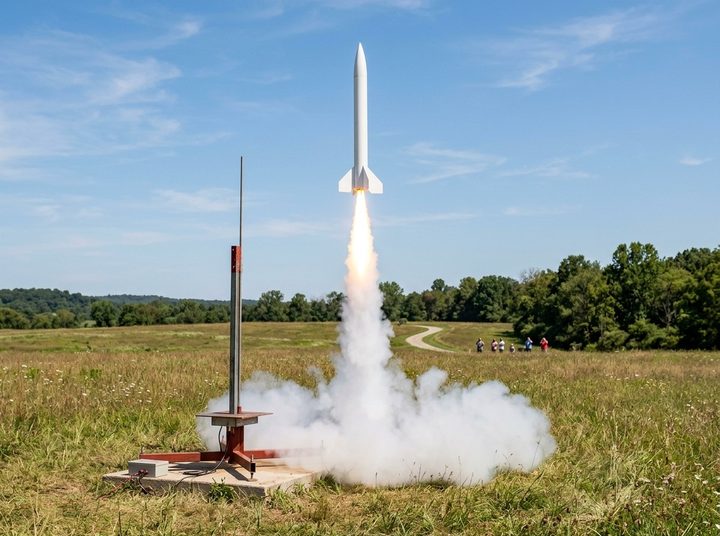
A model rocket is launched vertically from the ground. Its motion occurs in two distinct stages.
- Stage 1 (First 10 seconds): The rocket engine burns, producing an acceleration of $a(t) = 0.6t$ m s⁻² for $0 \le t \le 10$, where $t$ is the time in seconds after launch. The rocket starts from rest at ground level.
- Stage 2 (After 10 seconds): At $t = 10$ seconds, the first-stage engine cuts out and a second, smaller engine fires, providing a constant acceleration of 4 m s⁻².
Calculate the total height of the rocket above the ground after it has been travelling for a total of 25 seconds.
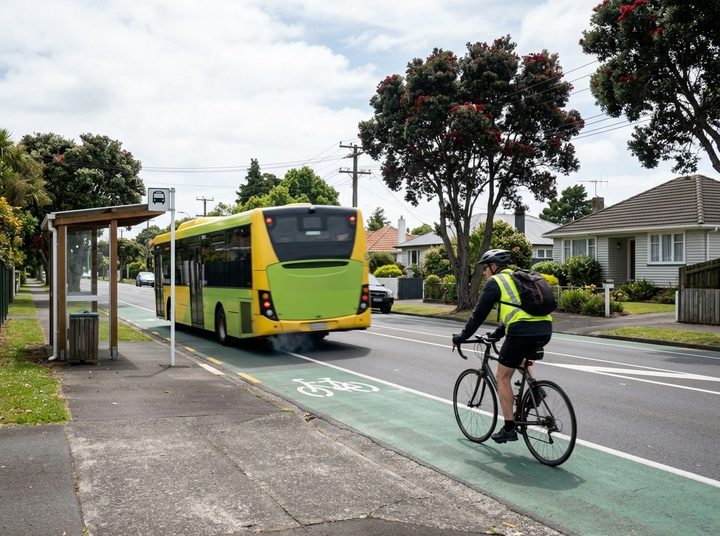
A bus pulls away from a bus stop, starting from rest. Its acceleration is a constant $1$ m s⁻².
At the moment the bus starts, a cyclist riding at a steady $5$ m s⁻¹ is already $12$ m past the bus stop, travelling in the same direction.
Use calculus to find how far from the bus stop the bus overtakes the cyclist.
A radio-controlled car moves along a straight track. Its velocity $t$ seconds after it leaves the start line is
$v(t) = 0.3t^2 - 1.8t + 2.4$
metres per second. A positive velocity means the car is moving away from the start line.
Find the total distance the car travels in the first 5 seconds.