L1 Mathematical Reasoning
Question Bank
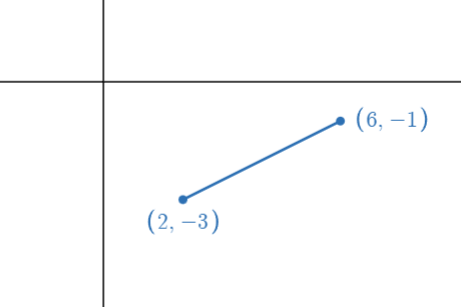
Calculate the length of the line segment shown in the diagram below.
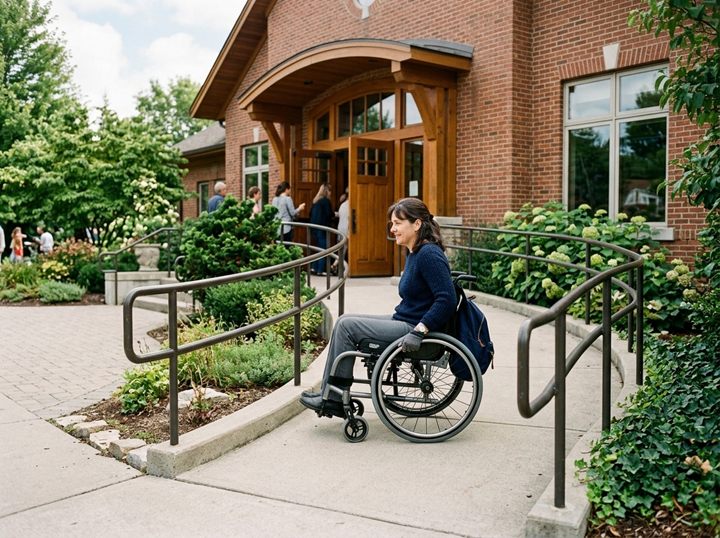
A wheelchair ramp has a length of 8 metres and makes an angle of 15° with the ground, as shown in the diagram.
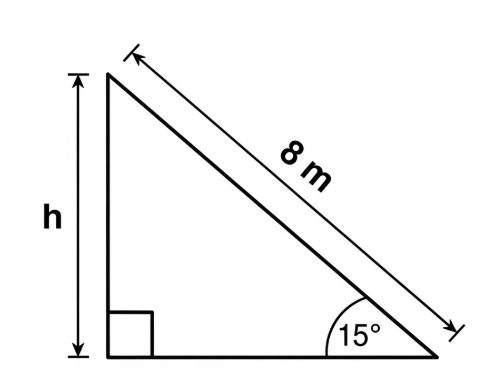
Calculate the vertical height, $h$, of the ramp.
A 5-metre ladder leans against a wall. The base of the ladder is 1.8 metres away from the base of the wall.
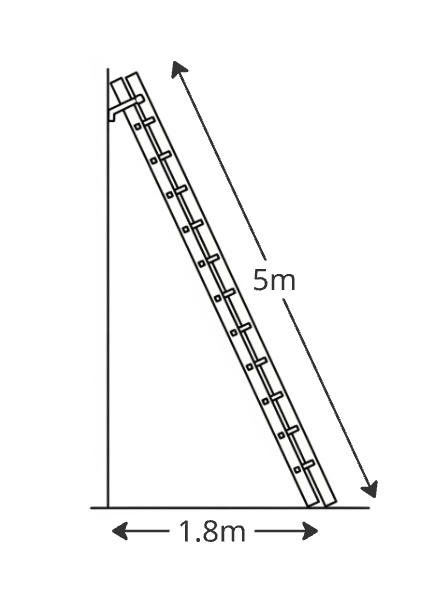
Calculate the angle that the ladder makes with the ground.
A tramper walks 5 km from her campsite on a bearing of 135°.
Calculate how far South and how far East she has travelled from her starting point.
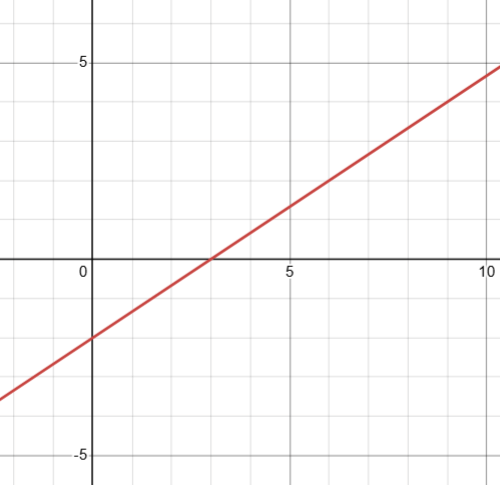
Find the angle the line makes with the x-axis.
A storage box is a cuboid ABCDEFGH. It is 60 cm long, 40 cm wide and 30 cm high.
(i) Calculate the length of the diagonal AC across the base of the box.
(ii) A thin metal rod fits exactly inside the box, from corner A to corner G. Calculate the length of the rod, AG.
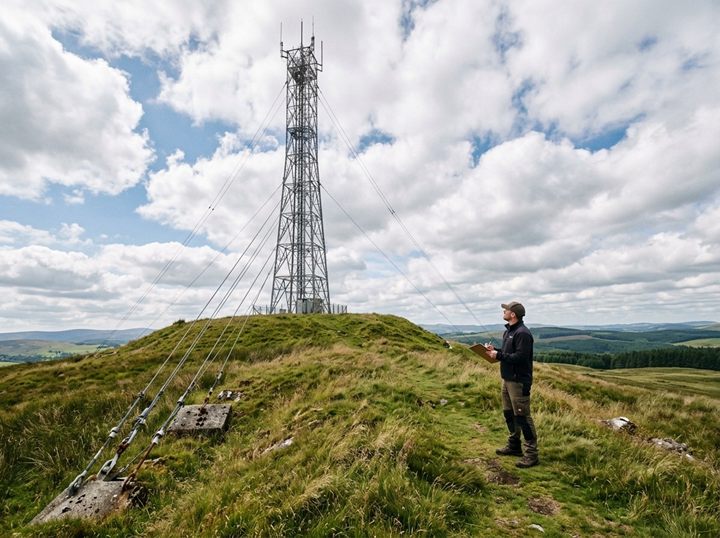
A surveyor stands $45 \text{ m}$ away from the base of a radio mast. The angle of elevation from the surveyor to the top of the mast is $32^\circ$. Calculate the height of the radio mast, giving your answer to the nearest whole metre.
An aircraft is being tracked from an airport control tower. The technician stands at the top of the tower, which is $100 \text{ m}$ high. The angle of elevation from the technician's eye level to the aircraft is $25^\circ$. The aircraft is at a horizontal distance of $600 \text{ m}$ from the base of the control tower, as shown in the diagram below.
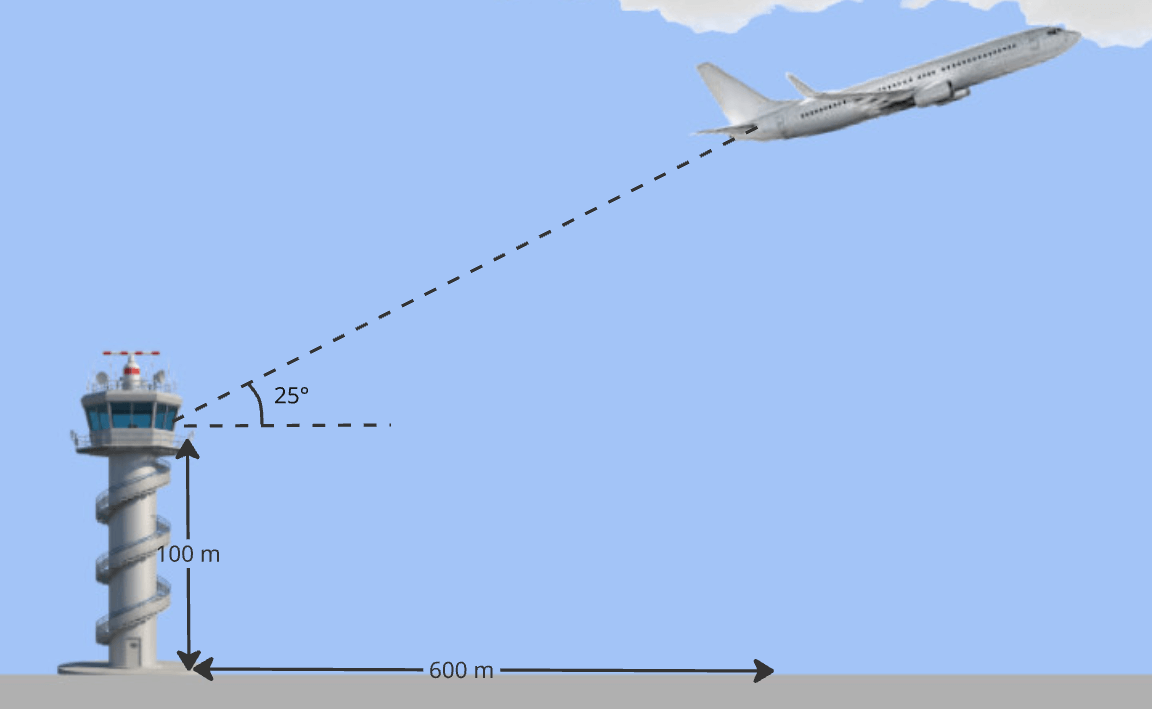
Calculate the total vertical height ($h$) of the aircraft above the ground level. Give your final answer to the nearest metre.
A builder has marked out the foundation for a rectangular deck. The foundation measures 8.5 metres long and 6.2 metres wide. To check if the corners are perfect 90° angles, she measures the diagonal and finds it to be 10.7 metres, as shown in the diagram.
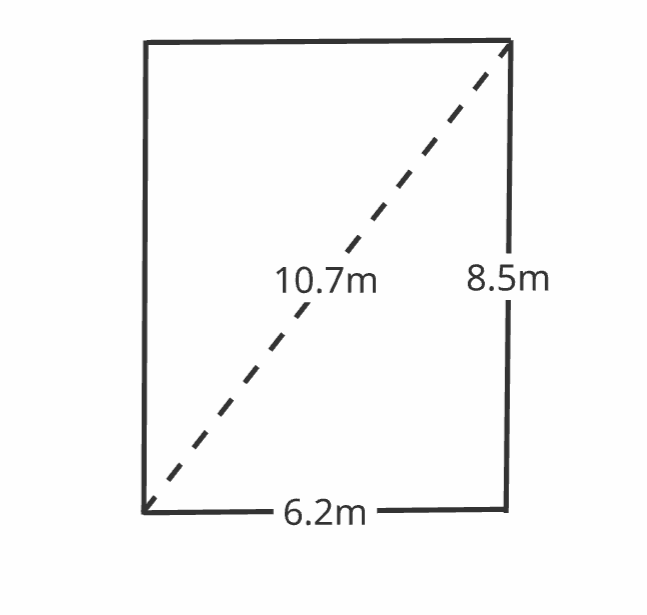
By using Pythagoras' theorem, determine whether the foundation is a true rectangle (i.e., if the corners are right-angles). Justify your answer with calculations.
For the line segment shown in the diagram below:
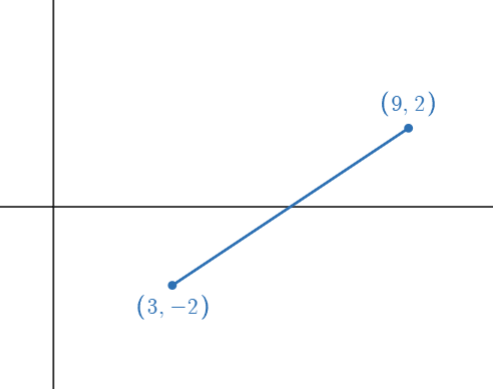
(i) Calculate the length of the line segment.
(ii) Calculate the angle the line segment makes with the horizontal.
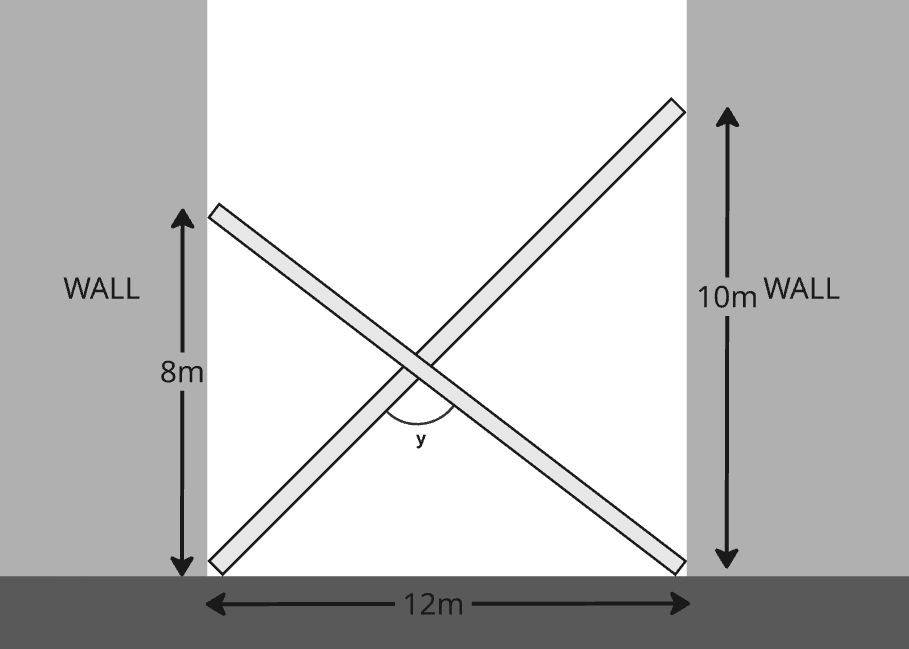
Two ladders are placed in an alley that is 12 metres wide. As shown in the diagram, one ladder rests 8 metres up one wall, and the other rests 10 metres up the opposite wall.
Calculate the size of the obtuse angle, $y$, where the two ladders cross.
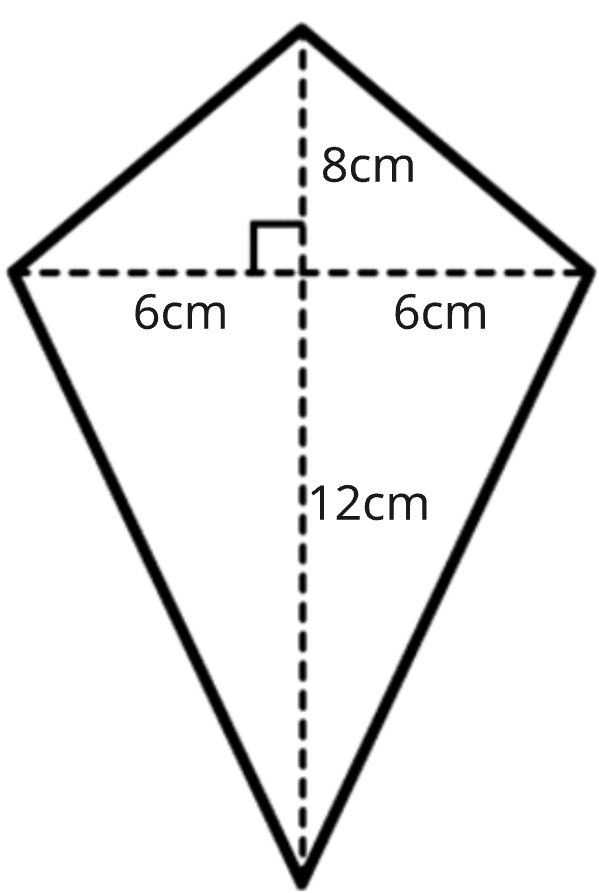
A kite has diagonals of length 20 cm and 12 cm. The 20 cm diagonal is the axis of symmetry, and it is split into segments of 8 cm and 12 cm by the other diagonal. Find the perimeter of the kite.
A rectangular panel has a coloured stripe running through it, as shown in the diagram. The stripe is a parallelogram with a base of 5 cm along the bottom edge of the panel.
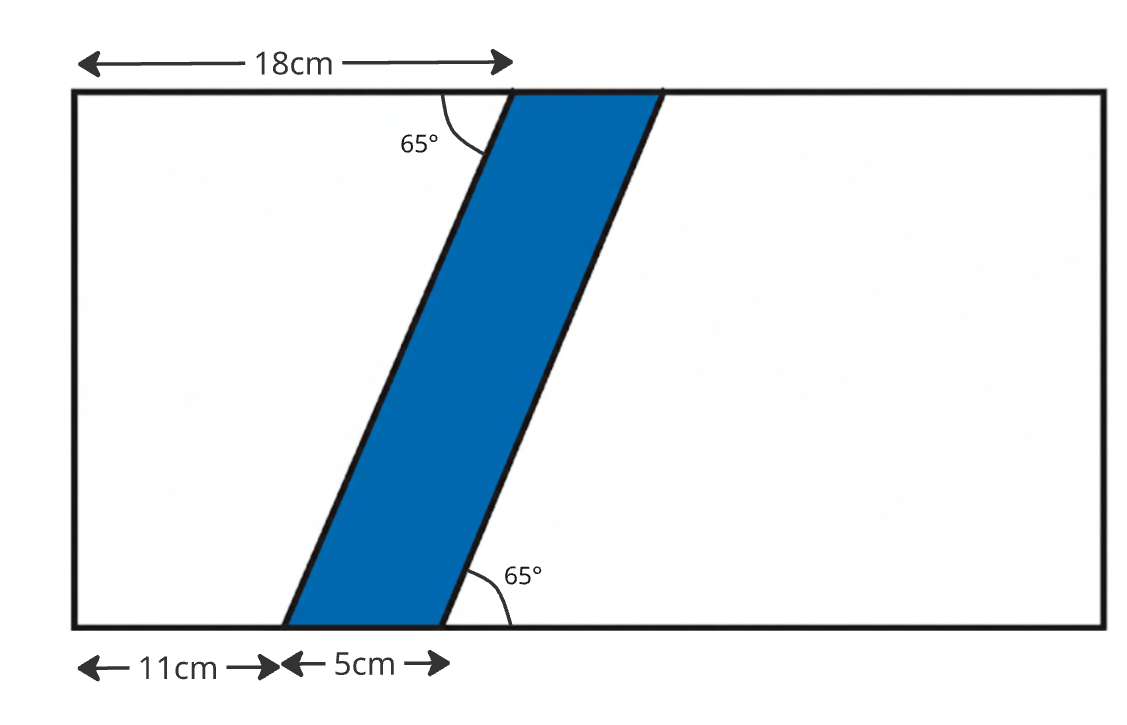
Calculate the area of the stripe.
The top of a cliff is $50 \text{ m}$ vertically above sea level. The angle of depression from the top of the cliff to a boat on the sea is $14^\circ$. Calculate the horizontal distance from the base of the cliff to the boat, giving your answer to three significant figures.
From the top of a viewing platform that is $25 \text{ m}$ high, the angle of depression to a parked car on the ground is $58^\circ$. Calculate the direct distance along the line of sight from the top of the platform to the car. Give your answer correct to two decimal places.

A kayaker paddles 4 km due South from a wharf, then turns and paddles 3 km due West to a beach.
What is the bearing of the wharf from the beach?
Two rescue boats leave the same port at the same time to search for a distress flare.
Boat A travels 90 km on a bearing of 040°.
Boat B travels 120 km on a bearing of 130°.
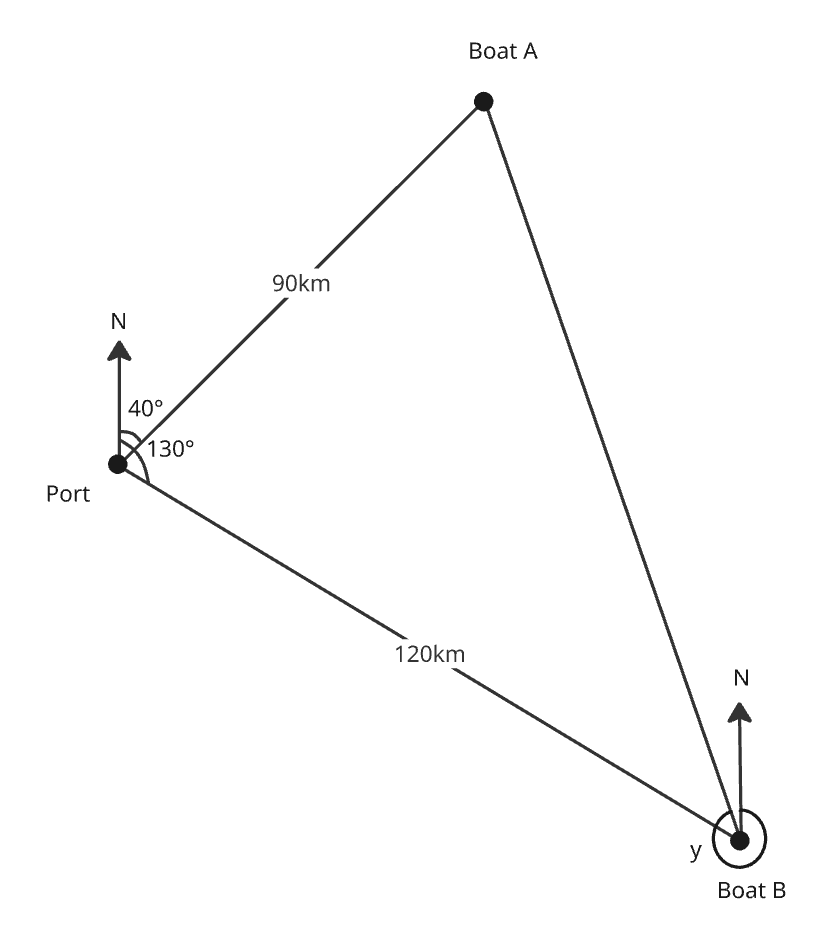
(i) Find the direct distance between the two boats.
(ii) Find the bearing of Boat A from Boat B, shown as angle 'y' in the diagram.
A ship is sailing offshore from a lighthouse. The lighthouse structure is $75 \text{ m}$ tall, and an observer stands on a viewing platform that is $10 \text{ m}$ below the very top of the lighthouse. The angle of depression from the observer to the ship is measured as $16^\circ$. The diagram below illustrates the situation.
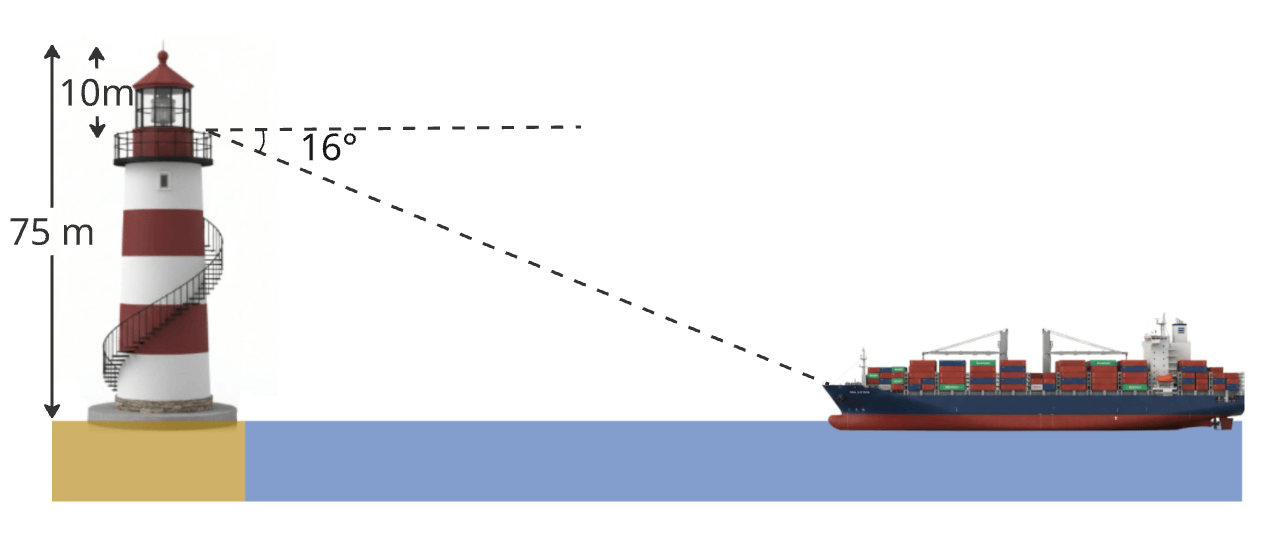
Calculate the horizontal distance from the base of the lighthouse to the ship, giving your answer to two decimal places.
A room is a cuboid 8 m long, 6 m wide and 3 m high. A string is stretched tight from corner A on the floor to the opposite corner G on the ceiling.
(i) Calculate the length of the diagonal AC across the floor.
(ii) Calculate the angle $\theta$ that the string makes with the floor.
Anna and Beth stand on a uniform staircase at points A and B respectively, as shown in the diagram. Points A and B are both located at the midpoints of their respective stair treads. 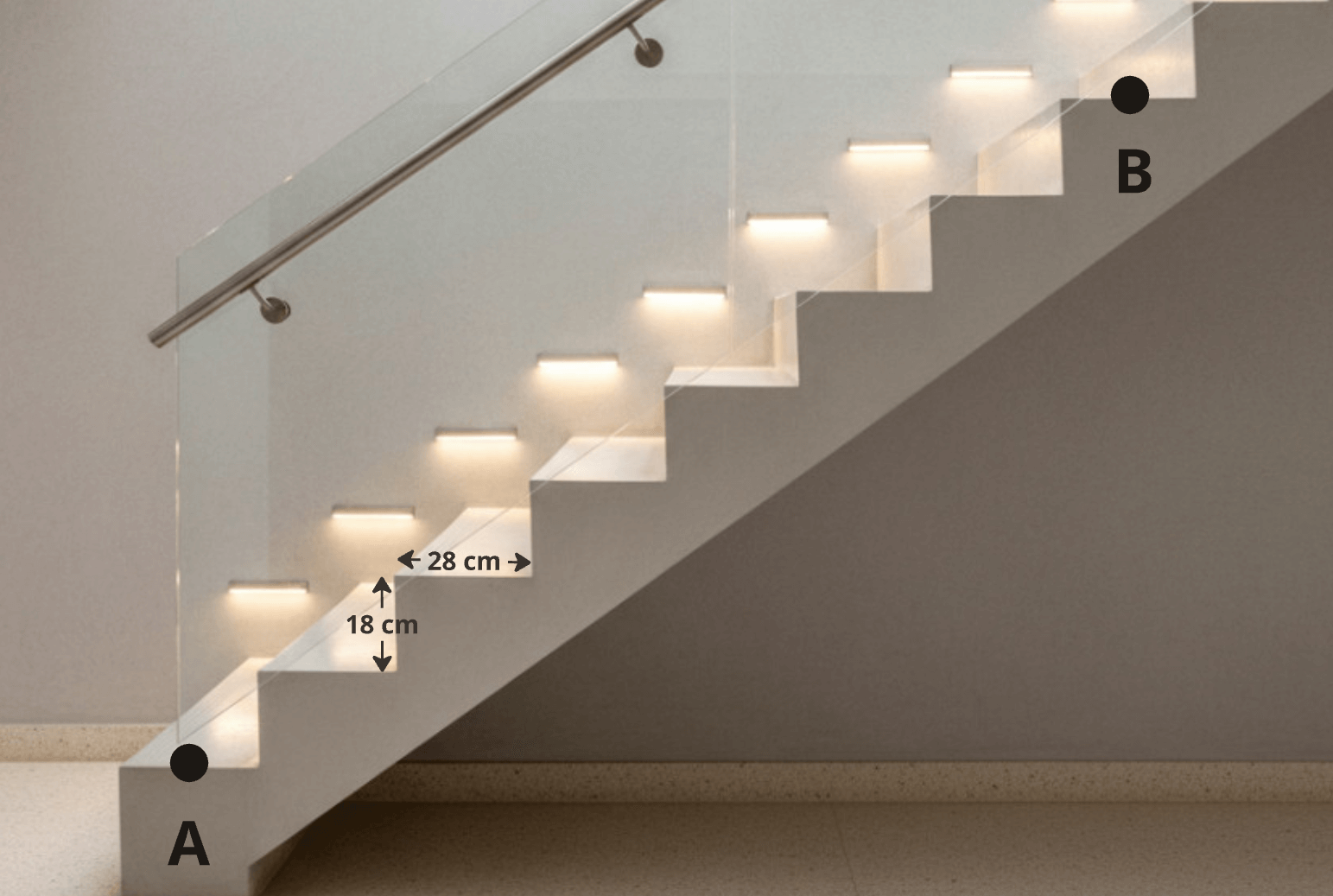
Each stair has a height (rise) of $18 \text{ cm}$ and a width (run) of $28 \text{ cm}$. Find the direct distance between Anna (at A) and Beth (at B), giving your answer to one decimal place.
Two vertical transmission towers, Tower A and Tower B, stand on level ground. Tower A is $80 \text{ m}$ tall, and Tower B is $100 \text{ m}$ tall. A surveyor stands at a point $P$ on the ground directly between the two towers. The angle of elevation from $P$ to the top of Tower A is $25^\circ$, and the angle of elevation from $P$ to the top of Tower B is $18^\circ$. The diagram illustrates the setup.
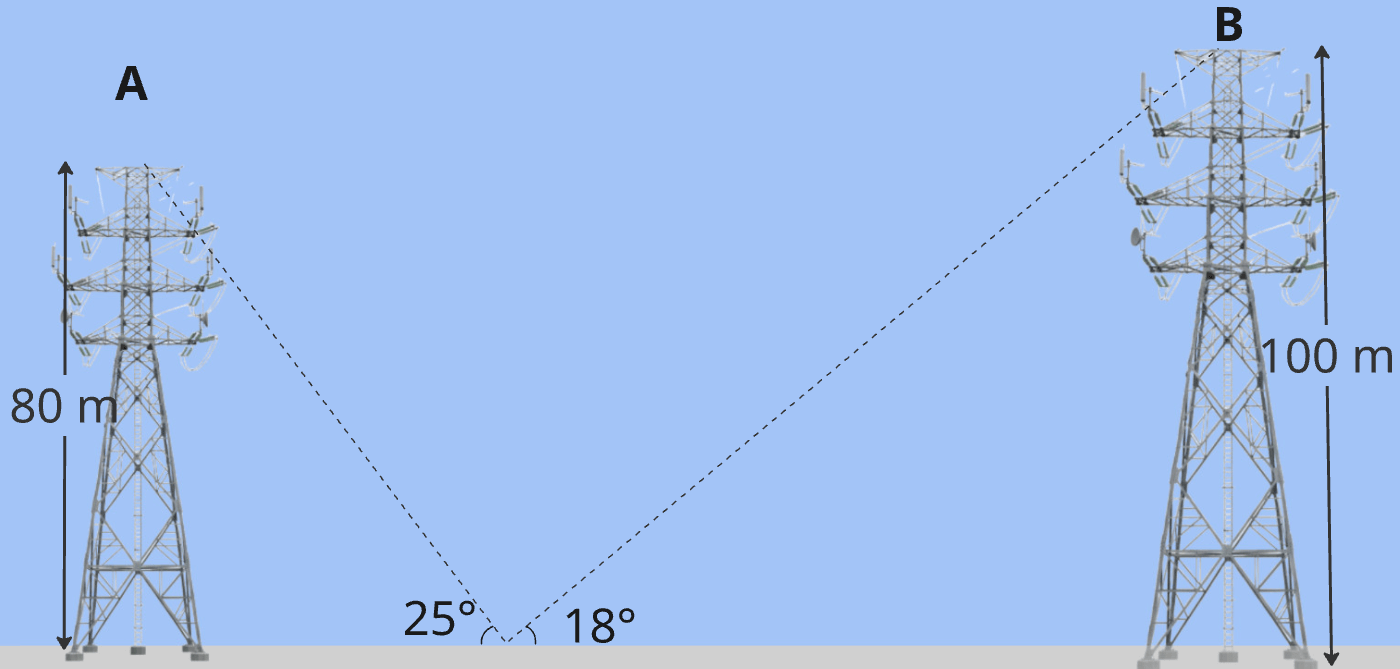
Calculate the total horizontal distance between Tower A and Tower B, correct to one decimal place.
The diagram shows a pyramid with a rectangular base ABCD. Its top, T, is directly above the corner A, so the edge AT is vertical.
AB = 9 m, BC = 12 m and AT = 8 m.
(i) Calculate the length of the sloping edge CT.
(ii) Calculate the angle $\theta$ between the edge CT and the base.
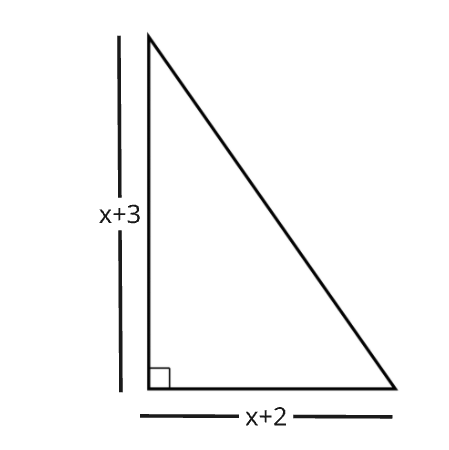
The right-angled triangle shown has a hypotenuse of $\sqrt{41}$ cm. Calculate this value of x.
A treasure map says to go from the old oak tree (O) 50m on a bearing of 060° to a rock (R). From the rock, you must walk 40m due North to find the treasure (T), as represented in the diagram.
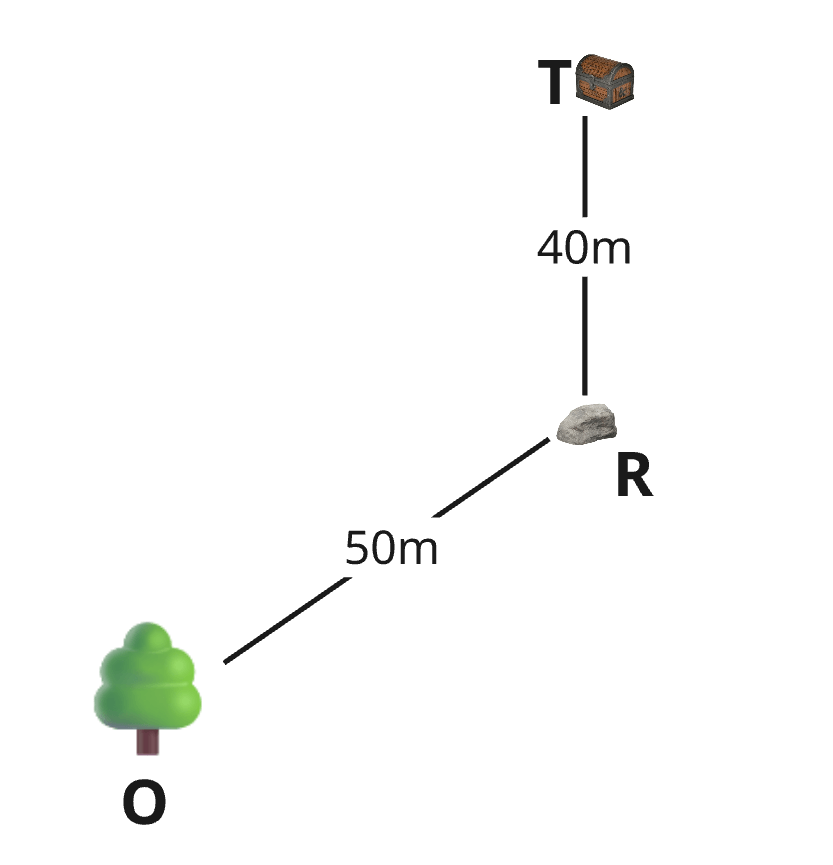
Calculate the direct distance from the old oak tree to the treasure.
A flagpole PV stands vertically at the corner P of a flat, horizontal courtyard. The courtyard is a triangle PQR with a right angle at P.
The flagpole is 6 m tall. From Q, the angle of elevation of the top of the pole, V, is 35°. On the ground, angle PQR = 40°.
Calculate the angle of elevation of V from R, marked $\theta$.
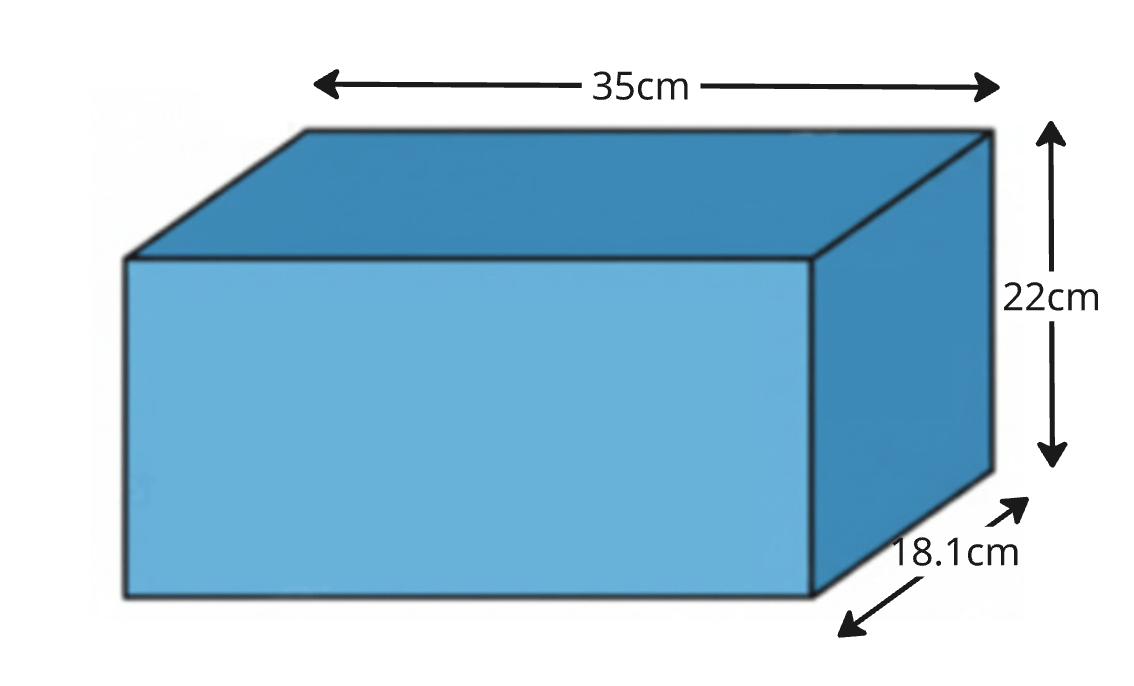
An artist needs to pack a special paintbrush for shipping. The longest brush she has is 45 cm long. Her only available box has the internal dimensions shown in the diagram.
To fit the brush in the box, it must be placed along the longest possible straight line, from one bottom corner to the opposite top corner (the space diagonal). Determine if the 45 cm paintbrush will fit in the box. You must justify your answer with calculations.
A right-angled triangle has side lengths which follow a linear sequence (i.e., they have a common difference). If the shortest side is 12 cm, what are the other two sides? You must use an algebraic method to find your answer.

An equilateral triangle has a base of $2x$. Find an expression for its area in terms of $x$.
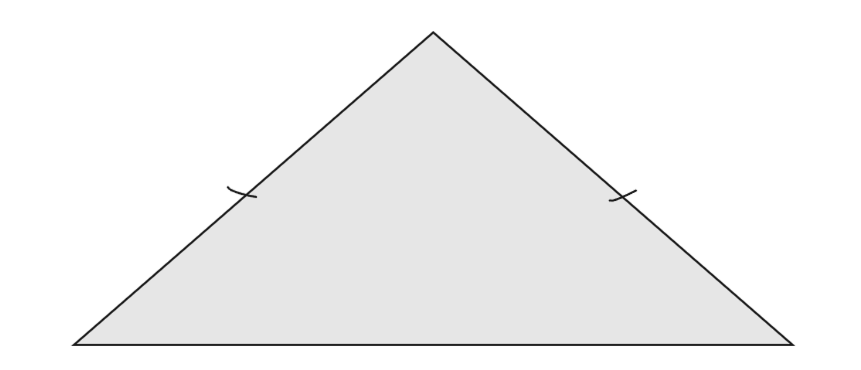
The sides of an isosceles triangle are in the ratio 8 : 5 : 5. If the area of the triangle is 84 cm², what is the perimeter?
The diagram shows a regular octagon. The distance from the center to any corner is $d$.
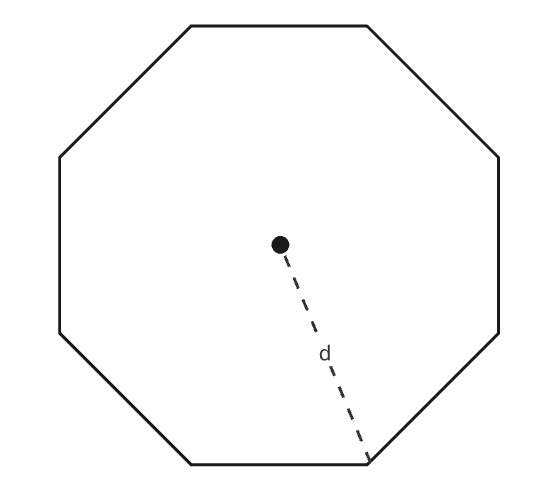
(i) Find an expression for the perimeter of the octagon in terms of $d$.
(ii) Find an expression for the area of the octagon in terms of $d$.
A regular octagon is divided up by drawing lines from each vertex to the 'opposite' vertex, and a length is marked $d$, as shown in the diagram below.
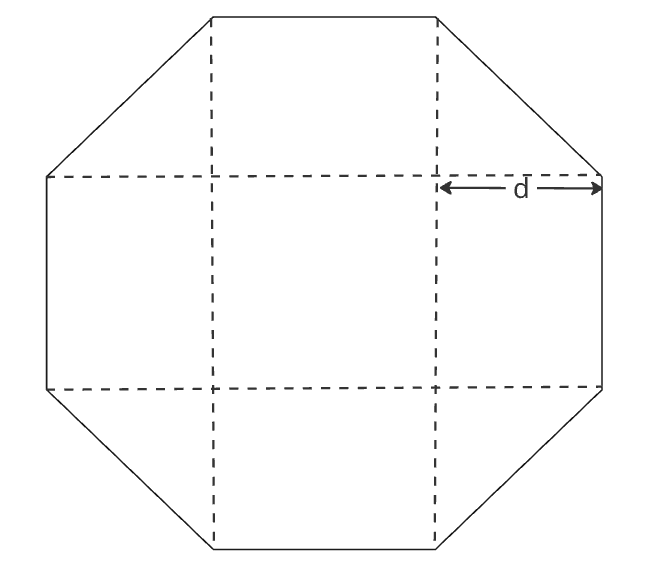
Find an expression for the total area of the octagon in terms of $d$.
A regular hexagon is divided into two rectangles and four triangles as shown. The distance $k$ is the height of the triangles.
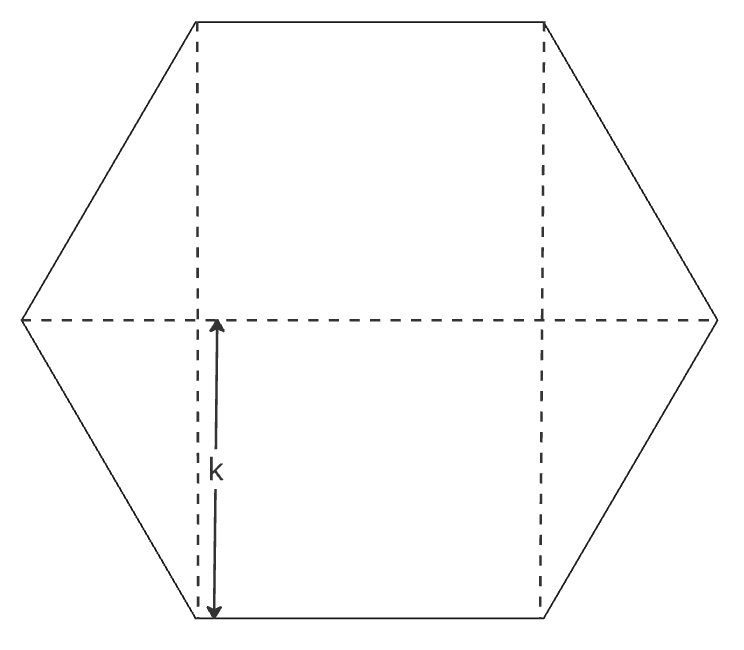
(i) Merit Find an expression for the perimeter of the hexagon in terms of $k$.
(ii) Excellence Find an expression for the area of the hexagon in terms of $k$.
The diagram below shows a regular hexagon. The perpendicular distance from the centre of the hexagon to any side is $d$.
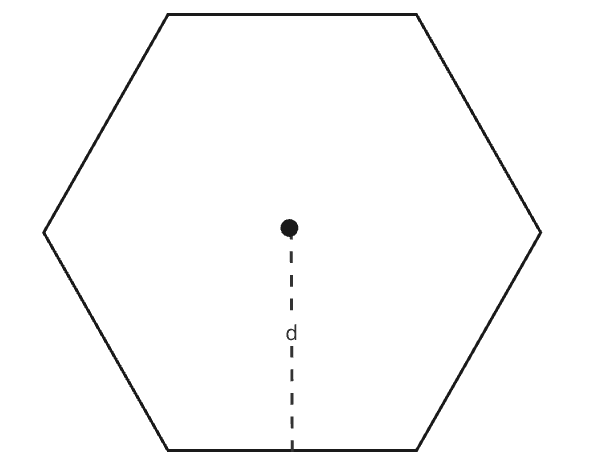
(i) Find an expression for the perimeter of the hexagon in terms of $d$.
(ii) Find an expression for the area of the hexagon in terms of $d$.
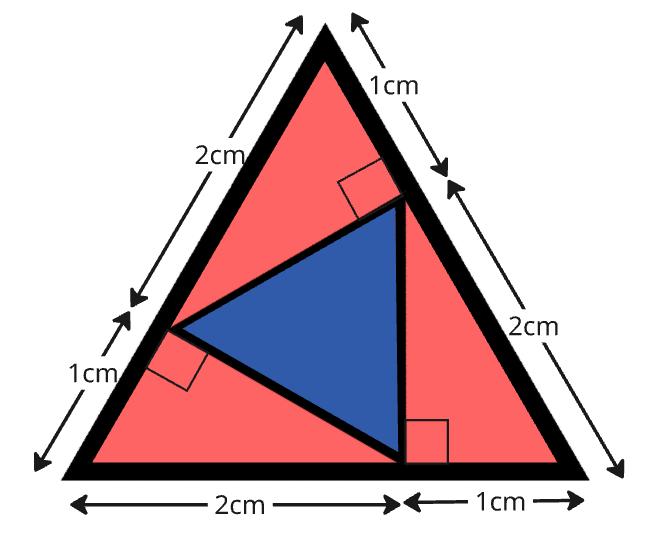
An artist is designing a triangular stained-glass window. The design consists of a large outer equilateral triangle containing a smaller blue equilateral triangle. As shown in the diagram, the space between them is made up of three identical red right-angled triangles.
The side lengths of the large triangle are 3 cm. Each of the red triangles has a short side of 1 cm and a hypotenuse of 2 cm.
Calculate the ratio of the total area of the red glass to the area of the blue glass. Show your working.
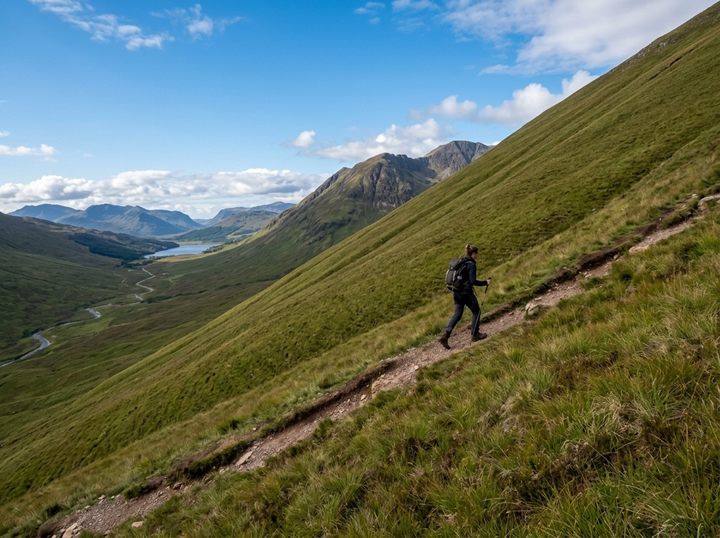
A hillside is a flat rectangle ABCD that slopes at 25° to the horizontal. Its bottom edge, AB, is horizontal and 400 m long. The edge AD runs straight up the slope and is 150 m long.
A walking track runs in a straight line from A to C.
(i) Calculate the height of C above the level of AB.
(ii) Calculate the angle that the track AC makes with the horizontal.
(iii) The steepest way up the hill is straight up the slope, at 25°. Explain why the track is much less steep.
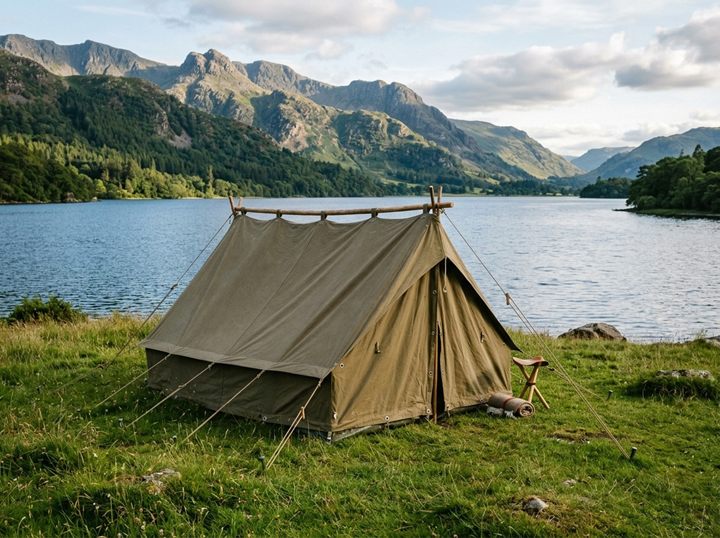
A ridge tent is a triangular prism. Each end is an isosceles triangle with a base of 1.8 m and two sloping sides of 1.5 m. The tent is 2.4 m long and stands on flat ground.
A string of lights runs in a straight line from the bottom front corner A to the far end of the ridge, Q. M is the point on the ground directly below Q.
(i) Show that the height of the tent is 1.2 m.
(ii) Calculate the length of the string AQ.
(iii) Calculate the angle $\theta$ between the string and the ground.
A ship sails from Port A for 100 km on a bearing of 120°. It then changes course and sails for 150 km on a bearing of 220° to reach Port C. The ship's path is represented by the basic triangle in the diagram below.
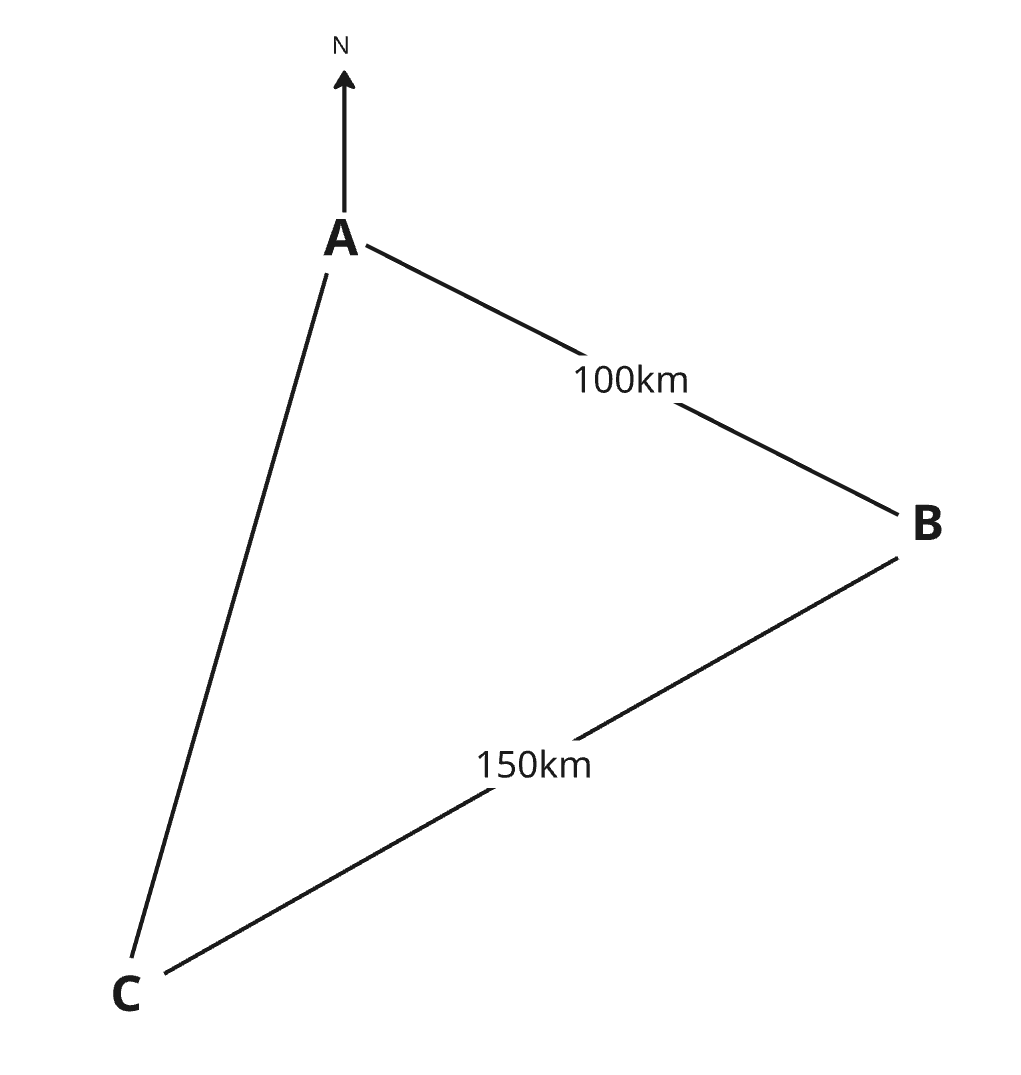
Calculate the bearing of Port A from Port C.
A hiker (H) is in a park and can see two towers, T1 and T2, which she knows are on a straight east-west track 20 km apart. From the hiker's position, the bearing to tower T1 is 315°, and the bearing to tower T2 is 45°.
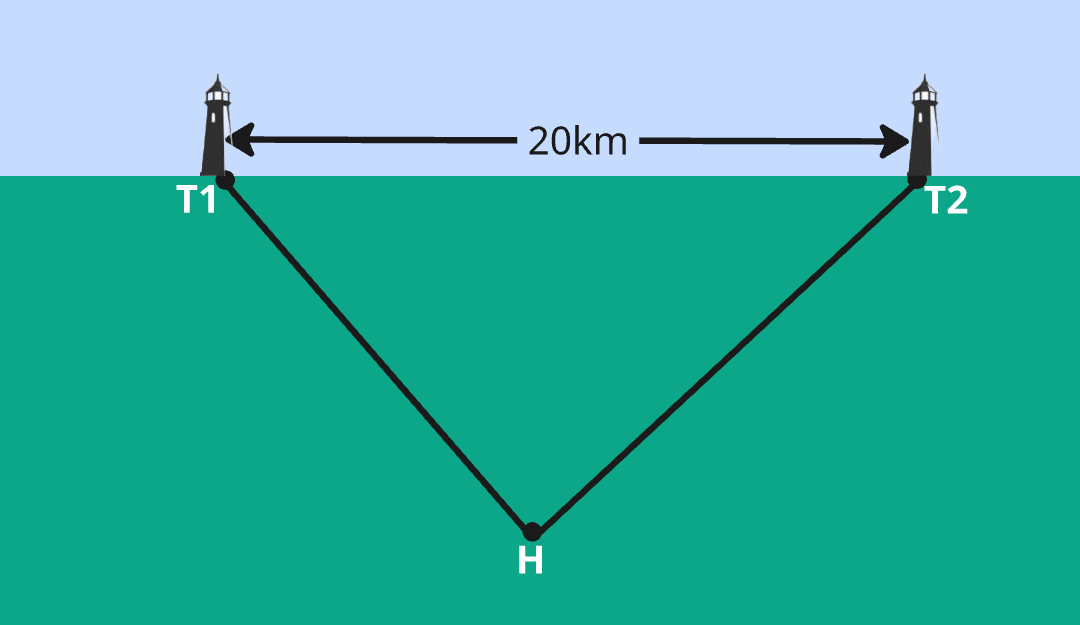
Calculate the shortest distance from the hiker to the track. You must fully justify your answer.
Two eagles are hunting a lizard on the ground. Their positions relative to the lizard are shown in the diagram below.
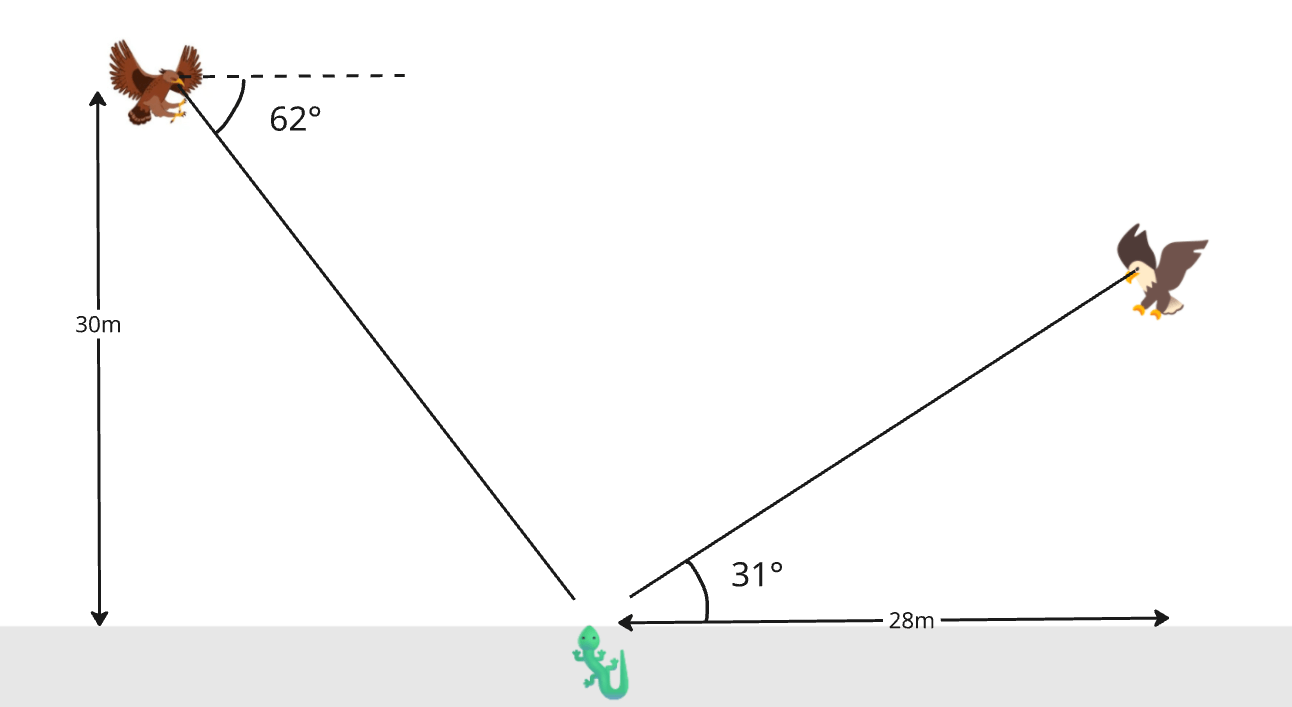
(i) By calculating the direct distance from the lizard to each eagle, determine which eagle is closer. You must justify your answer with calculations.
(ii) Calculate the direct distance between the two eagles.